
How to Lower Alkalinity in a Pool (Without Crashing the pH)
To lower total alkalinity (TA), use the acid-and-aeration method:
- Add muriatic acid to bring pH down to about 7.0–7.2. This lowers TA too.
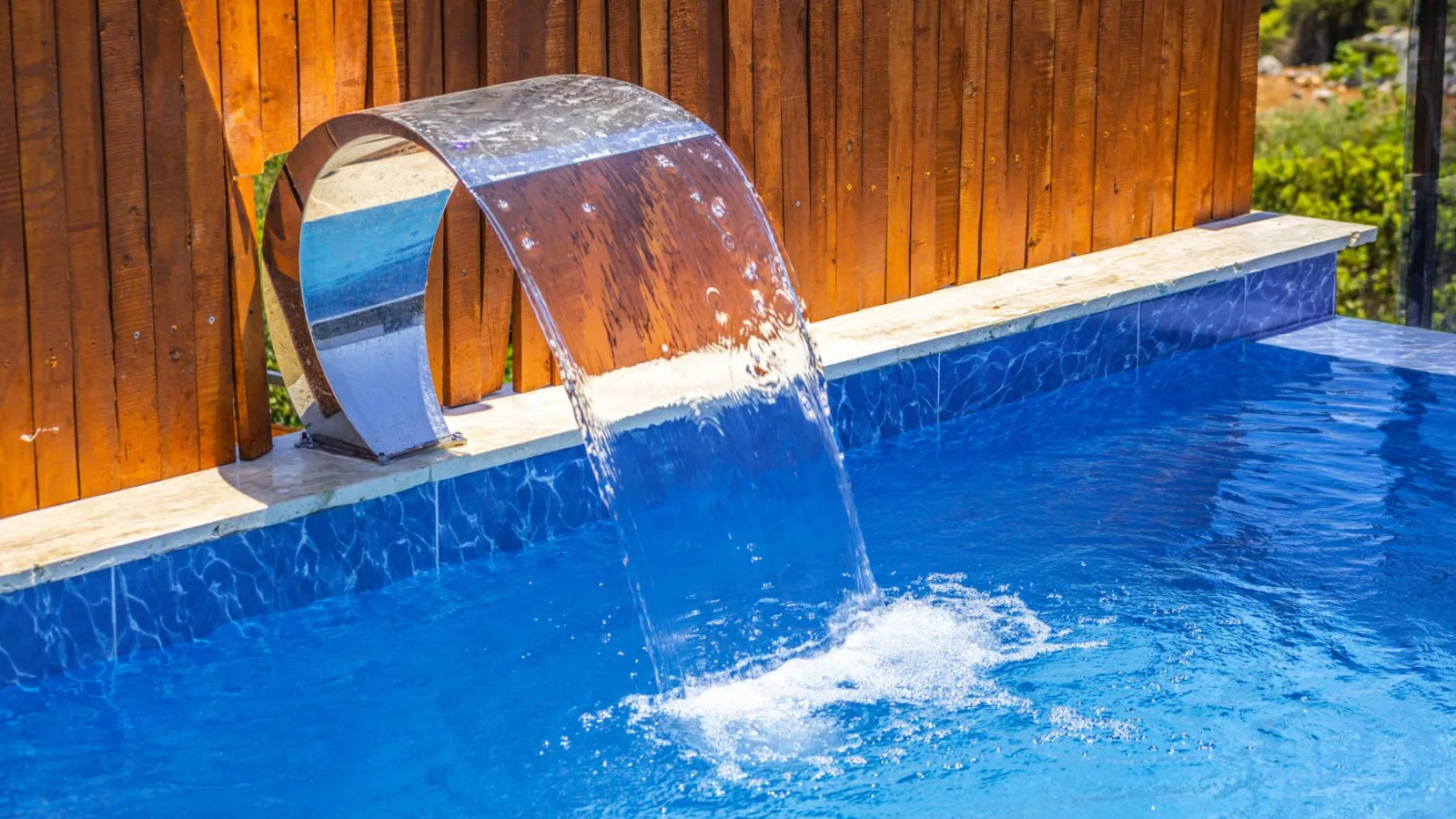
- Aerate the water (fountains, jets aimed up, splashing) until pH climbs back to 7.4–7.6.
- Repeat until TA is in range.
How much acid: about 26 fl oz of 31.45% muriatic acid per 10,000 gallons lowers TA by 10 ppm.
Why aeration: it raises pH without adding alkalinity back. That is why it is the only practical way to lower TA "without lowering pH" for good.
Quick answer: how to lower alkalinity in a pool
- Test TA and pH. Only lower TA if it's above about 120 ppm, or if pH keeps rising every few days.
- Add acid: use up to 1 quart of muriatic acid per 10,000 gallons per round, poured in front of a return jet with the pump running.
- Wait and retest: after an hour, pH should be around 7.0–7.2.
- Aerate: run water features and point the jets up for 12–48 hours, until pH reaches 7.4–7.6.
- Repeat until TA reaches your target (usually 60–100 ppm).
Do you actually need to lower alkalinity?
Lower TA when it's above about 120 ppm, or when high TA keeps pushing pH up and you're adding acid every few days. If TA is 120–140 ppm but pH holds steady at 7.4–7.6 and the water is clear, you can leave it alone.
Why high TA is a problem. Alkalinity is mostly bicarbonate. Bicarbonate slowly turns into CO₂ that escapes the water, and each time that happens pH goes up. So the more alkalinity you have, the faster pH climbs.
High TA usually causes:
- pH that rises constantly;
- cloudy water and scale, especially with high calcium;
- a need for a lot of acid every week.
| Your setup | Good TA target |
|---|---|
| Liquid chlorine or bleach | 60–80 ppm |
| Salt water chlorine generator | 60–80 ppm |
| Trichlor tablets (acidic) | 80–100 ppm |
| Cal-hypo shock regularly | 60–80 ppm |
How much acid lowers alkalinity?
About 26 fl oz of 31.45% muriatic acid per 10,000 gallons lowers total alkalinity by 10 ppm. This matches the dosing table the Indiana Department of Health adapted from the National Swimming Pool Foundation handbook, and our own calculator.
| TA drop (10,000 gal) | 31.45% muriatic acid | 14.5% muriatic acid | Dry acid (sodium bisulfate) |
|---|---|---|---|
| 10 ppm | 26 fl oz | 55 fl oz | 2.1 lb |
| 20 ppm | 51 fl oz | 110 fl oz | 4.2 lb |
| 30 ppm | 77 fl oz | 165 fl oz | 6.4 lb |
Watch out for "1 pint per 10 ppm". Some guides say this, but a pint is only 16 fl oz, about 60% of what's needed. You'd under-dose and wonder why TA barely moved. Calculate yours with the muriatic acid calculator.
How to lower alkalinity step by step
Example.
- The pool: Tom has a 20,000-gallon plaster pool with a salt chlorine generator.
- The test: TA 150 ppm, pH 7.9, CYA 60.
- The problem: his pH climbs every few days.
- The target: TA 90 ppm, a drop of 60 ppm.
(Tom is an illustrative example; the doses are real calculations.)
The total acid needed: 26 fl oz × 6 (60 ppm ÷ 10) × 2 (20,000 ÷ 10,000) ≈ 307 fl oz, about 2.4 gallons.
That is far too much to add at once. It would crash pH below 7.0 and could etch the plaster. The Indiana Department of Health advises no more than 1 quart per 10,000 gallons at a time, with a retest about 12 hours later. So Tom works in rounds.
Round 1: add acid
- Measure: 2 quarts (64 fl oz) of 31.45% acid, which is 1 quart per 10,000 gallons. This lowers TA by about 12 ppm.
- Pour: with the pump running, pour it slowly in front of a return jet in the deep end. Keep it low to avoid splashing.
- Wait: let it run for an hour, then retest. pH has dropped to about 7.1.
Round 1: aerate
Aeration drives CO₂ out of the water, so pH rises without TA going back up.
Ways to aerate:
- aim every return jet up so it breaks the surface;
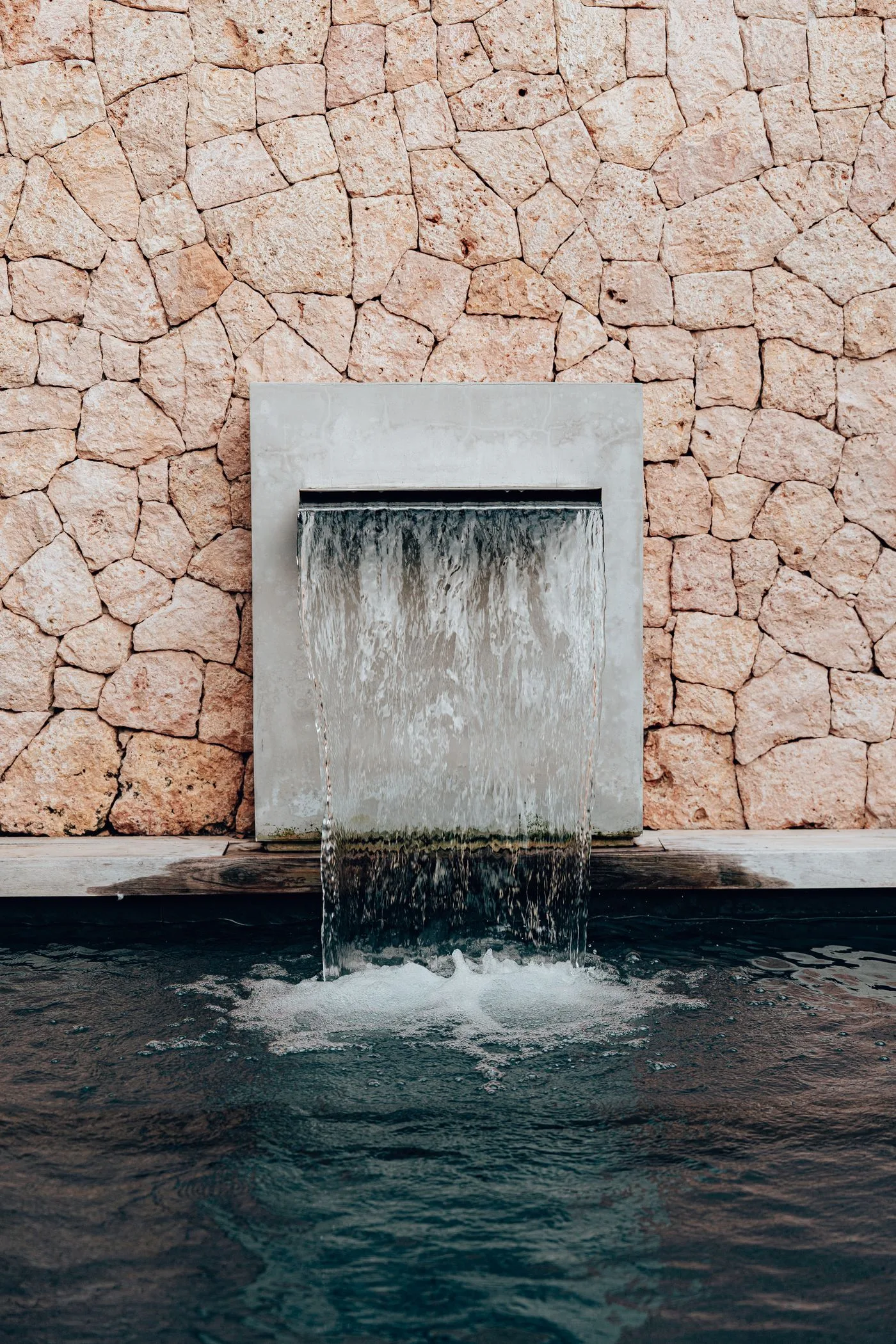
- turn on waterfalls, fountains, a spa spillover or an air bubbler;
- run the pump for longer.
How long: 12–48 hours, until pH is back to about 7.5. A pool cover traps CO₂, so leave it off.
Repeat
Tom's progress:
- After round 1: TA is about 138 ppm.
- Rounds 2–5: he repeats the same steps each day.
- After about 5 rounds (about a week): TA is 90 ppm and pH stays at 7.5.
Because TA is lower, his pH now rises much more slowly, so he needs far less acid each week.
Tips for faster aeration
- Aim returns up: point every return jet up and slightly toward the surface.
- Use features: run any water feature, spillover or bubbler you have, all day.
- Let people splash: a pool party is aeration.
- Air pump or fountain: a cheap air pump with an air stone, or a floating fountain, speeds things up in pools without features.
- Leave the cover off: a cover traps CO₂ and keeps pH from rising.
How to raise pH and alkalinity together
If both pH and alkalinity are low, use baking soda (sodium bicarbonate). It raises TA a lot and pH a little.
How much: about 1.4 lb of baking soda per 10,000 gallons raises TA by 10 ppm. Don't raise it more than about 50 ppm at a time.
The pool alkalinity calculator gives the exact dose, and how to raise pH in a pool explains when to use soda ash instead.
Safety
- Always add acid to water, never water to acid.
- Wear goggles and acid-resistant gloves.
- Never mix acid with chlorine. That releases toxic gas. Keep them at least 30 minutes apart.
- Store muriatic acid away from chlorine and out of reach of children.
The CDC estimates pool chemicals send about 13,500 people a year to U.S. emergency rooms.
Frequently asked questions
Can I lower alkalinity without lowering pH?
Not in one step. Any acid that lowers TA also lowers pH. The trick is to raise pH afterward with aeration, which doesn't add alkalinity back. Over a few rounds, TA goes down while pH ends up where it started.
How long does it take to lower pool alkalinity?
Each round takes about a day (acid plus 12–48 hours of aeration). A drop of 50–60 ppm usually takes about a week.
Does baking soda lower alkalinity?
No. Baking soda raises alkalinity. Use it only when TA is low.
What's the difference between pH and alkalinity?
pH measures how acidic or basic the water is right now. Alkalinity measures how much the water resists pH changes, its buffer. High alkalinity makes pH hard to lower and keeps pushing it up.
Should I pour acid in one spot to lower alkalinity?
Older advice says to pour acid in one spot with the pump off to lower TA more than pH. Where you pour makes little lasting difference; the aeration step is what separates TA from pH. Pour in front of a return jet with the pump running, which also protects the plaster from etching.
Can high alkalinity make my pool cloudy?
Yes. High alkalinity with high pH and calcium can make calcium carbonate cloud the water and form scale. Lowering TA and pH usually clears it. See how to clear cloudy pool water.
The bottom line
To lower alkalinity in a pool:
- Add acid in rounds (up to 1 quart per 10,000 gallons each time) to bring pH to about 7.0–7.2.
- Aerate until pH is back at 7.4–7.6.
- Repeat until TA reaches 60–100 ppm.
Each 10 ppm drop takes about 26 fl oz of muriatic acid per 10,000 gallons. Calculate your total with the free muriatic acid calculator.
Sources
- Indiana Department of Health, Water Chemistry Adjustment Guide (adapted from the NSPF Pool & Spa Operator Handbook) — muriatic acid 26 fl oz per 10 ppm TA per 10,000 gal; no more than 1 quart per 10,000 gal at a time. https://www.in.gov/health/eph/files/Chemical_adjustment_pool.pdf
- CDC, Pool Chemical–Associated Injuries, MMWR 68(19), 2019. https://www.cdc.gov/mmwr/volumes/68/wr/mm6819a2.htm
- Doses calculated with Pool Care's free pool calculators.

What do you think?
Share your experience, ask a question, or help another reader.
Loading comments…