
How to Clear Cloudy Pool Water Fast: 5 Steps That Work
To clear cloudy pool water fast, do these five things in order:
- Clean the filter and run the pump 24/7.
- Lower pH to 7.2–7.5.
- Shock to 40% of your CYA level (at least 10 ppm).
- Brush and vacuum.
- Add a clarifier (2–3 days) or a flocculant (about 24 hours plus a vacuum).
Most cloudy pools are clear again in 24 to 72 hours. Until you can see the drain at the bottom of the deep end, nobody should swim.
Quick answer: the 5-step fast fix
- Filter: clean or backwash it, then run the pump 24 hours a day until the water clears.
- pH: test, then bring pH down to 7.2–7.5 so the chlorine works at full strength.
- Shock: raise free chlorine to 40% of your CYA, with a minimum of 10 ppm.
- Clean: brush the walls and floor, skim, and vacuum.
- Clarify: use a clarifier for light haze or a flocculant for thick, milky water, never both.
The rest of this guide shows you how to find your cause in five minutes. It also works through the exact doses for a real 15,000-gallon pool, so you add the right amount the first time.
Why is my pool water cloudy? Find the cause in 5 minutes
Cloudy pool water almost always has one of four causes:
- Not enough sanitizer. Chlorine is too low for your stabilizer (CYA) level.
- Poor filtration. The filter is dirty, or the pump runs too few hours.
- Unbalanced water. High pH, high alkalinity or high calcium.
- Tiny particles. Pollen, dust, sunscreen and body oils are too small for the filter to catch.
Look at the water, run one quick test, and the cause is usually obvious:
| What you see | Most likely cause | Quick check | Fix first |
|---|---|---|---|
| Hazy with a green or yellow tint | Early algae, low chlorine | Free chlorine (FC) below 7.5% of your CYA | Shock to 40% of CYA, brush daily |
| Milky white or grey | High pH or calcium (calcium carbonate) | pH above 7.8, calcium above 400 ppm | Lower pH with acid, then filter |
| Cloudy after rain or a pool party | Contaminants used up the chlorine | FC near 0 | Shock, run the pump 24/7 |
| Cloudy right after shocking | Normal for 12–24 hours, or the shock was too weak | FC dropping fast overnight | Hold FC at shock level, keep filtering |
| Cloudy but chlorine reads fine | Filter or circulation problem | High filter pressure, pump runs under 8 hours | Clean the filter, run 24/7, add clarifier |
| Dull after a new fill or new plaster | Fine dust, metals or calcium | Water source, pH | Filter 24/7, keep pH 7.2–7.5 |
Example: Maria has a 15,000-gallon plaster pool in Phoenix. It turned milky white the morning after a July 4th party with 20 swimmers. Her test strip shows FC 0.5 ppm, pH 7.9, alkalinity 100 ppm and CYA 40 ppm. That is two problems at once. Sunscreen and sweat used up the chlorine, and the high pH makes what chlorine is left work poorly. We will fix Maria's pool step by step below. (Maria is an illustrative example; the numbers are real calculations.)
How to clear cloudy pool water fast (step by step)
The fastest way to clear a cloudy pool is to fix the filter and the chemistry first, and only then add a clearing product. A clarifier or flocculant poured into a pool with no chlorine and a dirty filter just wastes money.
Step 1: Clean the filter and run the pump 24/7
The filter does the actual clearing, so it must be clean and running non-stop.
- Sand or DE filter: backwash when the pressure gauge reads about 8–10 psi above its clean reading (check your filter's manual).
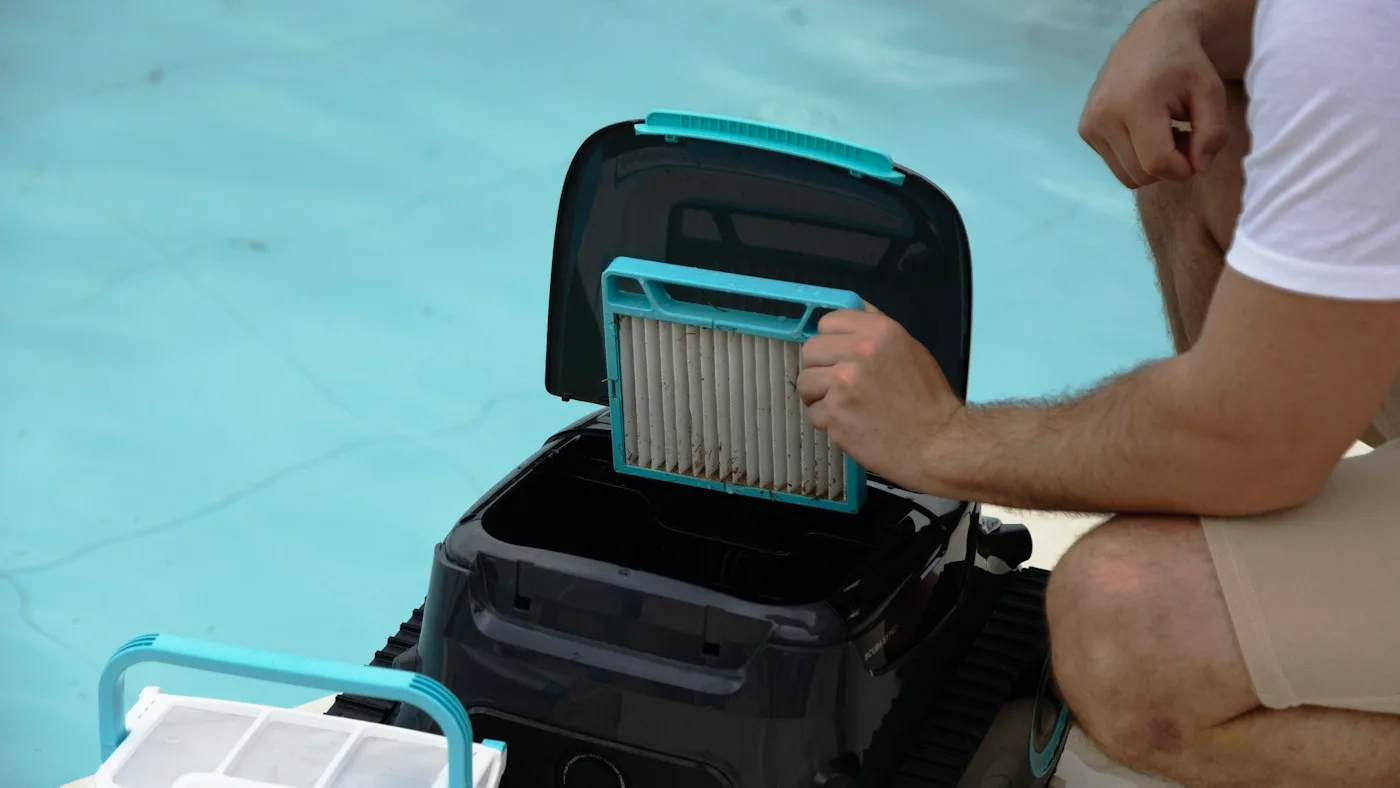
- Cartridge filter: take the cartridge out and hose it from top to bottom. Soak it in filter cleaner if it is greasy.
- Baskets: empty the skimmer and pump baskets so water flows freely.
- Return jets: angle them down and in the same direction to move water off the floor.
- Run time: run the pump 24 hours a day until the water is clear. Then drop back to at least one full turnover a day. Use the pool pump run time calculator to find your hours.
Step 2: Test, then fix pH (and alkalinity) first
Lower pH to 7.2–7.5 before you shock, because chlorine is noticeably more active at the low end of the pH range. Shocking at pH 8.0 wastes part of your chlorine.
- Test: check free chlorine, pH, total alkalinity and CYA. Test strips are fine for a first look. A FAS-DPD drop kit, such as Taylor's K-2006, is far more accurate at shock levels.
- Alkalinity: if total alkalinity is above 120 ppm, it will keep pushing pH back up. Lower it gradually (see how much muriatic acid).
- pH: if pH is high, add muriatic acid to the deep end with the pump running. Wait 30 minutes and retest.
Maria's pool:
- pH 7.9, target 7.5, alkalinity 100 ppm, CYA 40 ppm.
- Dose: about 20 fl oz of 31.45% muriatic acid, poured in front of a return jet.
- Our muriatic acid calculator does this math for your pool in seconds.
Step 3: Shock to the right level for your CYA
Shock means raising free chlorine to 40% of your CYA (stabilizer) level, with a minimum of 10 ppm. Then hold it there until the water is clear. Stabilizer protects chlorine from the sun, but it also slows it down. The more CYA in the water, the more chlorine you need to do the same job. This is why a "one bag per 10,000 gallons" rule fails so often.
| Your CYA (ppm) | Shock to (free chlorine, ppm) |
|---|---|
| 0–25 | 10 |
| 30 | 12 |
| 40 | 16 |
| 50 | 20 |
| 60 | 24 |
| 80 | 32 (drain some water first) |
Maria's pool (15,000 gallons, FC 0.5 ppm, CYA 40 ppm) needs to go up to 16 ppm, an increase of 15.5 ppm. That takes:
- Liquid chlorine 10%: about 2⅓ gallons
- Liquid chlorine 12.5%: about 1⅞ gallons
- Cal-hypo 65% (granular shock): about 3 lb. This also raises calcium hardness by about 11 ppm.
Because 15.5 ppm is a large jump, add it in two parts:
- Add half at dusk with the pump running, poured slowly around the edges.
- Retest after 4–6 hours.
- Add the rest only if free chlorine is still below 16 ppm.
Our pool shock calculator does this split for you.
Myth check: "1 lb of shock per 10,000 gallons."
- One pound of 65% cal-hypo raises free chlorine in 10,000 gallons by only about 7.8 ppm.
- That is fine at CYA 20, but below the shock level at CYA 40 or higher.
- So the water can stay cloudy even though you "shocked it."
Liquid or granular?
- Liquid chlorine works fastest and adds nothing else to the water.
- Cal-hypo adds calcium. If your calcium is already high, it can make the water cloudier (calcium carbonate).
- Dichlor adds stabilizer. About 9 ppm of CYA comes with every 10 ppm of chlorine.
Step 4: Brush, skim and vacuum
Brushing loosens algae and fine dirt from the walls and floor so the filter and the chlorine can reach them.

- Brush: do the walls, steps and floor once or twice a day while you are shocking.
- Skim and vacuum: remove leaves and debris so they don't keep using up chlorine.
- Robotic cleaner: park it while the water is very cloudy. It stirs fine particles back up that the main filter should be catching.
Step 5: Add a clarifier or a flocculant (pick one)
Use a clarifier for light haze and a flocculant for thick, milky water when you need the pool fast. Never use both together. They work in opposite ways and cancel each other out.
| Pool clarifier | Pool flocculant ("floc") | |
|---|---|---|
| How it works | Clumps tiny particles so the filter can catch them | Makes particles heavy so they sink to the floor |
| Best for | Light to medium haze | Very cloudy or milky water |
| Time to clear | 48–72 hours | About 24 hours (8–12 h settling + vacuuming) |
| Filter | Runs 24/7 | Pump off while it settles |
| Effort | Low: pour and wait | High: vacuum the floor slowly, to waste |
| Water loss | None | Several inches (vacuumed to waste) |
How to floc a pool, step by step:
- Prepare: balance pH (most flocs work best around 7.2–7.6) and top the water up a few inches above normal.
- Add the floc: add it as the label says, run the pump for about 2 hours to mix it, then turn the pump off.
- Let it settle: leave the water completely still for 8–12 hours, usually overnight. A cloud of debris settles on the floor.
- Vacuum to waste: set a sand or DE filter's multiport valve to WASTE and vacuum slowly, so you don't stir the cloud back up. With a cartridge filter, use a submersible pump or a waste line, because the cartridge will clog instantly.
- Finish: refill, retest and rebalance.
How long does it take to clear a cloudy pool?
Most cloudy pools clear in 24 to 72 hours: about a day with a flocculant and 2–3 days with a clarifier. Algae and a sand filter can stretch that to a week.
| Time | What to do | What you should see |
|---|---|---|
| Hour 0 | Clean filter, fix pH, add the first half of the shock, pump 24/7 | Water may look cloudier as algae dies |
| Hours 4–8 | Retest, add the rest of the shock, brush | Chlorine holding near the shock level |
| Day 1 | Retest morning, noon and night; top up chlorine to the shock level | Haze starts thinning, floor slowly visible |
| Days 2–3 | Keep filtering (clarifier users) or vacuum (floc users) | Clear water, main drain visible |
When it takes longer:
- Sand filter: sand catches the finest particles more slowly than a cartridge or DE filter.
- Algae: A full algae cleanup can take from a few days to two weeks.
- High CYA: above about 80 ppm, the shock level becomes so high that partly draining and refilling is faster.
- Dirty filter: if the pressure climbs during the cleanup, clean the filter again.
Pool still cloudy after shocking? 6 reasons
If your pool is still cloudy 24 hours after shocking, one of these six problems is usually to blame:
- The shock level was too low for your CYA. The fix is to hold free chlorine at 40% of CYA, not just dump one dose.
- pH is too high. At pH 8.0, much of the chlorine you add is wasted. Lower it to 7.2–7.5.
- The filter is dirty or runs too few hours. Clean it and run it 24/7.
- Dead algae is still in the water. That's the grey-white haze after a green pool. Keep filtering and brushing.
- Cal-hypo went into water that was already high in calcium, which forms calcium carbonate cloudiness. Use liquid chlorine instead, and check your water with the LSI calculator.
- Phosphates, metals or oils. Phosphates feed algae. Keep them below about 500 ppb. Metals from new fill water can cloud the water and stain surfaces.
How to know you're done. The finish test needs all three of these:
- Combined chlorine: 0.5 ppm or lower.
- Overnight chlorine loss: free chlorine falls 1 ppm or less from sunset to sunrise.
- Clarity: the water is crystal clear.
Is it safe to swim in a cloudy pool?
No. Do not swim in a cloudy pool until you can clearly see the drain at the bottom of the deep end. That is the CDC's simple test before getting into any pool. Cloudy water hides a swimmer in trouble from rescuers, and it often means the sanitizer is not keeping up.
Also wait until free chlorine has dropped back to a normal level for your CYA (4 ppm or lower, the swim limit on most chlorine product labels). Even then, crystal-clear water is not proof the water is germ-free. The CDC notes that clean-looking water can still carry germs. Keep testing and keep chlorine in range.
How to keep your pool from getting cloudy again
Cloudy water comes back when chlorine, filtration or balance slips. These habits prevent most cases:
- Test 2–3 times a week: free chlorine and pH. Test alkalinity, calcium and CYA every 2–4 weeks.
- Keep chlorine high enough: keep free chlorine at about 7.5% of your CYA, and at least 3 ppm. With CYA 40, that means 3 ppm or more.
- Shock after heavy use, storms or heat waves, before the water turns.
- Run the pump long enough for at least one full turnover a day. Clean the filter when the pressure climbs.
- Keep the water balanced:
- pH 7.4–7.6
- alkalinity 60–120 ppm
- calcium 200–400 ppm for plaster
- CYA 30–50 ppm
- Use the right dose every time: the all-in-one pool calculator gives you every dose from your test results.
Frequently asked questions
How do I clear a cloudy pool overnight?
Use a flocculant. Balance pH, add the floc, circulate for 2 hours, then turn the pump off overnight. In the morning, vacuum the settled debris to waste. A clarifier cannot clear a pool overnight; it needs 2–3 days with the filter running.
Does baking soda clear a cloudy pool?
No. Baking soda raises total alkalinity, and slightly raises pH. If your alkalinity is low, fixing it helps keep pH steady. But adding baking soda to water that already has high pH or alkalinity can make cloudiness worse.
Can too much chlorine make a pool cloudy?
Liquid chlorine itself doesn't cloud the water. Cal-hypo shock can, because it adds calcium and raises pH briefly. Pre-dissolve it in a bucket of water, or switch to liquid chlorine if your calcium is above 400 ppm.
Why is my pool cloudy after rain?
Rain washes dirt, pollen and organic matter into the pool and dilutes the chlorine. That leaves the sanitizer too low to keep up. Test right after a storm, shock if free chlorine is low, and run the pump 24 hours.
Is clarifier or shock better for cloudy water?
Shock comes first, because it fixes the cause (low sanitizer or algae). A clarifier only helps the filter remove the leftover particles. Adding clarifier to an unshocked pool usually does nothing.
How do I clear a cloudy pool without chemicals?
If the chemistry is already balanced and chlorine is in range, clean the filter and run the pump 24/7. Brush and vacuum daily as well. That alone clears many mildly hazy pools in 1–2 days. If free chlorine is low, though, you need chlorine. There is no safe chemical-free shortcut.
The bottom line
Clearing cloudy pool water fast is a matter of order, not of more products:
- Clean the filter and run it around the clock.
- Lower pH to 7.2–7.5.
- Shock to 40% of your CYA.
- Brush and vacuum.
- Finish with a clarifier or a flocculant.
Follow those five steps and most pools are swimmable again in 24 to 72 hours. Work out your exact doses first with the free pool shock calculator.
Sources
- CDC, Preventing Swimming-related Illnesses — "see the drain at the bottom of the deep end" and clear water vs germs. https://www.cdc.gov/healthy-swimming/prevention/index.html
- CDC, Model Aquatic Health Code (2024, 5th ed.) — clarity standard: bottom visible while the water is still. https://www.cdc.gov/model-aquatic-health-code/
- Dose figures calculated with Pool Care's free pool calculators (chlorine as Cl₂, 31.45% muriatic acid, 65% calcium hypochlorite).

What do you think?
Share your experience, ask a question, or help another reader.
Loading comments…