
How to Get Rid of Water Bugs in a Pool
To get rid of water bugs, remove their food: algae.
- The bugs: most "water bugs" in pools are water boatmen, which eat algae, and backswimmers, which eat the boatmen.
- The fix: skim and net out the bugs, brush and vacuum (to waste if you can, to remove eggs), shock the pool in the evening, and keep chlorine and pH in range.
- The result: once there's no algae, the boatmen leave, and the backswimmers follow.
Handle backswimmers with care: their bite feels like a bee sting.
Quick steps: water bugs in the pool
- Net out the bugs with a skimmer.
- Brush walls and floor, then vacuum, to waste if possible.
- Shock at dusk to kill algae, and run the pump overnight.
- Rebalance: free chlorine in range for your stabilizer, pH 7.4–7.6.
- Vacuum again the next day, and clean the filter.
- Prevent: keep chlorine up, use a cover, and switch off pool lights when you're not swimming.
Which water bugs are in your pool?
| Bug | What it looks like | Behavior | Bites? |
|---|---|---|---|
| Water boatman | Oval, brown, ¼–½ inch, long oar-like back legs | Swims right side up; often clings to the floor and walls | No |
| Backswimmer | Similar size, lighter boat-shaped back | Swims upside down; hangs at the surface | Yes, painful |
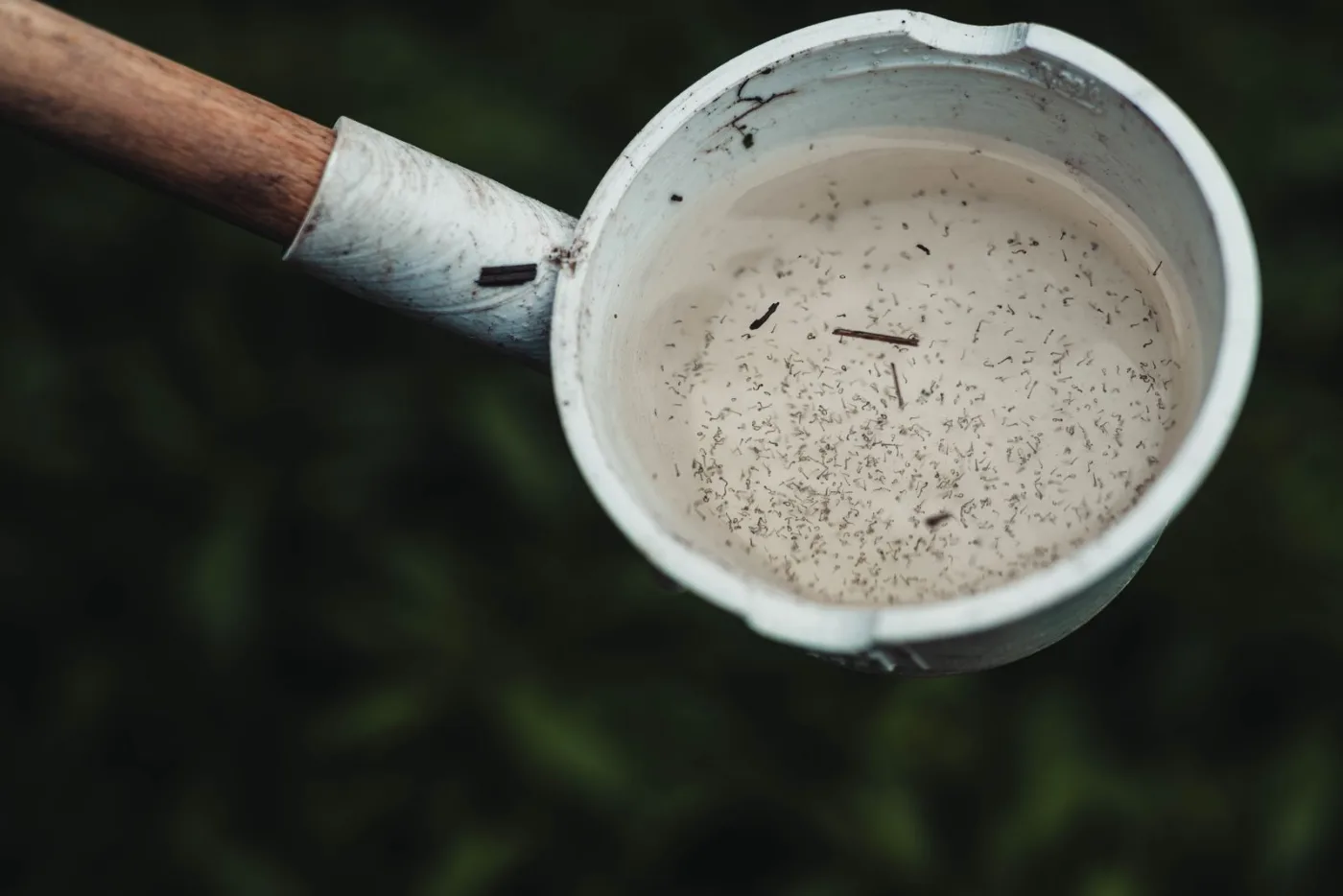
| Mosquito larvae | Tiny wrigglers near the surface | Wriggle up and down | No, but they become mosquitoes |
| Giant water bug | Large (1–2+ inches), flat, brown | Rare in pools; usually from nearby ponds | Yes, very painful |
The quickest check: if it swims on its back, it's a backswimmer. LSU AgCenter's pool pest guide notes that boatmen feed on algae, while backswimmers are predators and can bite.
Why water bugs come to your pool
- Algae: even a thin film of algae on walls, steps or in the filter feeds boatmen. They often show up before you can see the algae yourself.
- Lights: many water bugs fly at night and are drawn to pool and patio lights.
- Nearby water: ponds, creeks or neglected pools close by supply new bugs.
- Low chlorine: after a vacation, heavy rain or a busy weekend, algae grows quickly.
A neglected pool is also a mosquito nursery. A study in the CDC journal Emerging Infectious Diseases linked neglected backyard pools to a rise in West Nile virus cases in California.
How to get rid of water bugs, step by step
- Skim them out. Use a fine leaf net, and wear gloves around backswimmers. Release them away from the pool or dispose of them.
- Brush everything: walls, floor, steps, ladders and behind lights. This loosens algae and eggs stuck to surfaces.
- Vacuum. Vacuum to waste if your filter allows, so eggs and algae leave the pool instead of passing back through the filter.
- Check pH first, and adjust to 7.4–7.6 so chlorine works well. See how to lower pH.
- Shock in the evening. Raise free chlorine to shock level for your stabilizer (at least 10 ppm, higher with high CYA). The pool shock calculator gives the dose. Run the pump overnight.
- Brush and vacuum again the next day, then clean or backwash the filter, where algae and eggs collect.
- Repeat the shock if bugs or algae remain after 2–3 days.
- Swim only when free chlorine is back to 4 ppm or lower and pH is 7.2–7.8. See how long after adding chlorine you can swim.
What not to do
- Don't add insecticide to pool water. Products not labeled for pool use are illegal to apply that way, and they put swimmers at risk.
- Don't add dish soap. It foams, clogs the filter and upsets the water chemistry, and you'll still have algae.
- Don't pour oil on the water. It coats the pool, the tile line and the filter.
- Don't just keep netting. Without fixing the algae, new bugs fly in every night.
Example: bugs after a vacation
- The pool: the Johnsons came home after two weeks away to find dozens of boatmen on the floor of their 18,000-gallon pool and a few backswimmers at the surface.
- The readings: FC 0.5 ppm, pH 7.9, CYA 50 ppm. A faint green film covered the steps.
The 3-day plan:
- Day 1: net the bugs, brush, vacuum to waste, and lower pH to 7.5. At dusk, shock to about 20 ppm (40% of their CYA) and run the pump all night.
- Day 2: brush and vacuum again, and backwash the filter. Only a few boatmen are left.
- Day 3: the water is clear and the bugs are gone. They keep chlorine at 4–6 ppm for their CYA, and wait to swim until it reads 4 ppm or lower.
- Going forward: they add a timer so the pool light only comes on when someone swims.
(The Johnsons are an illustrative example; the shock target follows the Pool Care shock calculator's rule of at least 10 ppm or 40% of CYA.)
How to keep water bugs out of your pool
- Keep chlorine steady in the right range for your stabilizer; see what should the chlorine level be in a pool.
- Brush weekly, especially steps, corners and behind ladders, where algae starts.
- Run the pump long enough to turn the water over daily; use the pool pump run time calculator.
- Use a cover when the pool isn't in use. It blocks bugs and debris and cuts chlorine loss.
- Turn off pool and patio lights at night when nobody is swimming.
- Use a preventive algaecide occasionally if your pool keeps getting algae.
Do water bugs bite?
Water boatmen don't bite. Backswimmers can, usually when handled or trapped against skin. LSU AgCenter describes the bite as a nasty, stinging sensation, similar to a bee sting. Wash the bite with soap and water and use a cold pack. Seek medical care if you have signs of an allergic reaction, such as swelling of the face or trouble breathing.
Frequently asked questions
How do I get rid of water bugs in my pool?
Net them out, brush and vacuum, then shock the pool to kill the algae they feed on. Keep chlorine and pH in range, and the bugs won't come back.
How do water bugs get in my pool?
They fly in, often at night and attracted to lights, from nearby ponds, creeks or other pools. They stay if there's algae to eat.
Are water bugs harmful?
Boatmen are harmless. Backswimmers can give a painful bite. Neither spreads disease, but a neglected pool can also breed mosquitoes.
Why do I have water bugs but no visible algae?
Boatmen can find algae before you can see it: in the filter, behind lights, or on steps. Lights and nearby water also bring them. Brush thoroughly and shock.
Will chlorine kill water bugs?
Shock-level chlorine helps, mainly by killing their food. Some adult bugs survive by trapping air, so netting and vacuuming are still needed.
Can I put dish soap in my pool to kill water bugs?
It's not recommended. Soap foams, clogs the filter and throws off the water balance. Removing algae is safer and lasts longer.
The bottom line
- Water boatmen eat algae; backswimmers eat boatmen.
- Net, brush, vacuum, shock at dusk, and rebalance.
- Never add insecticide, soap or oil to pool water.
- Keep chlorine steady, brush weekly, cover the pool, and turn off the lights at night.
Sources
- LSU AgCenter, Pool Pests: water boatmen feed on algae and don't bite; backswimmers prey on insects and bite; shock and scrub to control them. https://www.lsuagcenter.com/topics/environment/insects/public_health/pool-pests
- Reisen WK et al., Delinquent Mortgages, Neglected Swimming Pools, and West Nile Virus, California, Emerging Infectious Diseases (CDC), Nov 2008. https://wwwnc.cdc.gov/eid/article/14/11/08-0719_article
- CDC, Home Pool and Hot Tub Water Treatment and Testing (2024): chlorine and pH targets. https://www.cdc.gov/healthy-swimming/about/home-pool-and-hot-tub-water-treatment-and-testing.html

What do you think?
Share your experience, ask a question, or help another reader.
Loading comments…