
How to Clean a DE Pool Filter
Backwash your DE filter when the pressure gauge reads 8–10 psi above its "clean" pressure, then add fresh DE through the skimmer. Once or twice a year, take the filter apart and hose the grids, because backwashing never removes all the old DE and oils. A clean filter typically takes about 1 lb of DE per 10 sq ft of filter area; after a backwash, add about 80% of that. Check your filter's label or manual for the exact amount. DE is a fine silica dust, so wear a dust mask when handling it.
Quick steps: DE filter cleaning
- Note the clean pressure after each cleaning and check it weekly.
- Backwash at 8–10 psi over clean: pump off, valve to BACKWASH, run until the sight glass clears, then RINSE.
- Recharge: add DE as a slurry into the skimmer with the pump running.
- Tear down once or twice a year: open the tank, hose the grids, inspect for tears, reassemble and recharge.
How DE filters work, and when to clean them
A DE filter holds a stack of fabric-covered grids (or fingers). You coat them with diatomaceous earth (DE), a powder made of tiny fossil shells. The DE layer, not the fabric, traps particles as small as a few microns, which makes DE the finest common pool filter.
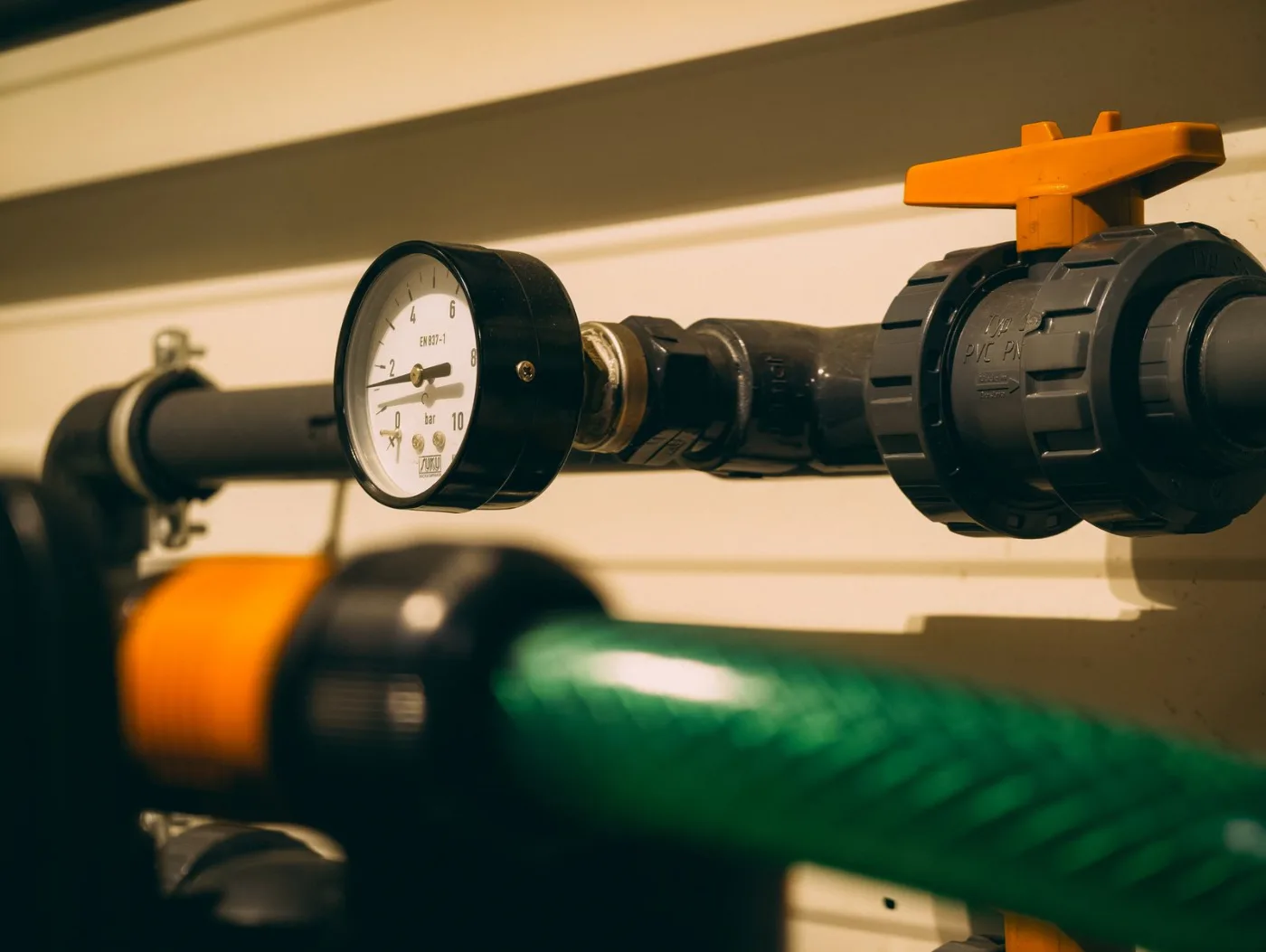
As dirt builds up, water struggles to get through and the pressure rises. That's your signal:
| Sign | What to do |
|---|---|
| Pressure is 8–10 psi above clean | Backwash and recharge |
| Pressure rises again within days of a backwash | Do a full teardown |
| DE or dirt blowing back into the pool | Check for a torn grid or a bad manifold |
| Start or end of the season | Full teardown |
| After an algae bloom or heavy debris | Backwash, and probably a teardown |
Don't backwash on a schedule if pressure is still low. A slightly dirty DE filter actually filters better, and every backwash wastes water and DE.
How to backwash a DE filter and recharge it
- Turn off the pump. Always switch the pump off before moving the multiport or push-pull valve.
- Set the valve to BACKWASH and roll out the backwash hose to an allowed drain area.
- Run the pump for 1–2 minutes, until the water in the sight glass or hose runs clear. Many owners "bump" it: backwash, stop, wait a minute, and repeat 2–3 times to shake more DE loose.
- Turn off the pump, set the valve to RINSE (if you have one), and run for 30 seconds.
- Return the valve to FILTER and start the pump.
- Add fresh DE right away. Weigh it out, mix it into a bucket of water to make a slurry, and pour it slowly into the skimmer nearest the filter while the pump runs. Never add dry DE straight into a filter tank.
- Write down the new clean pressure. It should be close to the original starting pressure.
How much DE after a backwash: about 80% of the full charge, because some old DE stays on the grids.
How to tear down and deep-clean a DE filter
Do this once or twice a year, or when backwashing no longer brings the pressure back down.
- Turn off the pump and breaker. Close any valves, open the air relief valve, and open the drain plug to empty the tank.
- Remove the clamp or lid and lift out the grid assembly carefully. Keep it together, and note how it fits.
- Hose the grids from top to bottom with a garden nozzle until the fabric looks clean. Don't use a pressure washer, which can tear the fabric.
- Soak if needed:
- Oils and lotions: soak in a filter cleaner or degreaser, following its label.
- Calcium scale: some grids need a mild acid soak afterwards. Never acid-soak before degreasing, which locks oils into the fabric.
- Inspect every grid for tears, holes and a broken frame. Replace damaged grids; a torn grid lets DE into the pool.
- Check the manifold and O-ring, then lubricate the tank O-ring with a pool lubricant.
- Reassemble, close the drain, fill the tank, and run the pump with the air relief open until water spurts out.
- Add a full DE charge through the skimmer, and record the clean pressure.
How much DE does my filter need?
Use the amount on your filter's label or in its manual. If you can't find it, these are typical full charges:
| Filter area | Full charge (about 1 lb / 10 sq ft) | After backwash (about 80%) |
|---|---|---|
| 24 sq ft | 2.5–3 lb | 2–2.5 lb |
| 36 sq ft | 3.5–4.5 lb | 3–3.5 lb |
| 48 sq ft | 5–6 lb | 4–5 lb |
| 60 sq ft | 6–7.5 lb | 5–6 lb |
| 72 sq ft | 7–9 lb | 6–7 lb |
The higher number in each range is for makers who specify 1 lb per 8 sq ft. Weigh your DE instead of counting scoops or cups; the volume of a pound varies by brand and how packed it is. Too little DE lets dirt reach the fabric and clog it. Far too much can bridge between grids and raise pressure.
Example: a 48 sq ft filter
- The filter: Mike's 48 sq ft DE filter read 12 psi clean in April. By July it reads 21 psi, 9 psi above clean.
- Backwash: he backwashes three short times until the water runs clear, then rinses.
- Recharge: the filter label calls for 6 lb for a full charge, so after the backwash he adds about 4.8 lb (80%) as a slurry in the skimmer.
- Result: pressure settles at 13 psi.
- Next spring: backwashes start lasting only a week, so he tears the filter down, finds oily grids, degreases and hoses them, and adds a full 6 lb charge.
(Mike is an illustrative example.)
DE safety and disposal
- Wear a dust mask (N95 or better) when pouring dry DE, and pour it gently to keep dust down. DE is a form of silica. US workplace limits treat even natural DE dust as a hazard, and most pool-grade DE is heat-treated ("calcined"), which can form crystalline silica. Crystalline silica dust is linked to lung disease, according to OSHA.
- Keep it wet when cleaning. Hose the grids rather than brushing dry DE, and don't let spent DE dry and blow around.
- Never send DE into storm drains, septic systems or the street. Many local codes ban it, because it clogs pipes and settles in streams. Backwash onto your own lawn or soil where allowed, or into a separation tank or bag and put the dried DE in the trash. Check your city's rules.
- Store DE dry and away from kids and pets.
DE filter troubleshooting
- DE in the pool:
- A torn grid or cracked manifold: tear down and inspect.
- A loose O-ring or standpipe seal: reseat or replace it.
- Too much DE: if you added more than the charge, the excess bridges over and blows into the pool. Backwash and add the correct amount.
- Pressure rises again quickly: the grids are clogged with oils or calcium. Tear down, degrease, then acid-soak if needed. High calcium or high pH can cause this. See how to reduce calcium hardness.
- Cloudy water with normal pressure: possibly too little DE, a torn grid letting water bypass, or a chemistry problem. See how to clear cloudy pool water.
- Pressure lower than normal: a clogged skimmer or pump basket, or an air leak on the suction side.
Frequently asked questions
How often should a DE pool filter be cleaned?
Backwash whenever pressure is 8–10 psi above clean, often every 1–3 months. Do a full teardown once or twice a year.
How much DE do I put back after backwashing?
About 80% of the full charge. For a 48 sq ft filter that takes 6 lb when clean, that's about 4.8 lb.
Can I add DE through the skimmer?
Yes, that's the normal way. Mix it into a bucket of water first and pour it slowly into the skimmer closest to the filter while the pump runs on FILTER.
Why is DE coming back into my pool?
Usually a torn grid, a cracked manifold, a loose seal, or too much DE. Tear the filter down and inspect it.
Can I clean DE grids with muriatic acid?
Only for calcium scale, and only after degreasing the oils off first. Use a mild solution and rinse thoroughly. Many owners just use a filter cleaner made for the purpose.
Is DE dangerous to breathe?
DE dust can irritate and harm the lungs, especially calcined pool-grade DE, which can contain crystalline silica. Wear an N95 mask and keep it damp.
The bottom line
- Backwash at 8–10 psi over clean, then recharge about 80% of the full DE charge.
- Tear down and hose the grids once or twice a year.
- Weigh your DE, add it as a slurry through the skimmer, and record the clean pressure.
- Wear a dust mask, and keep DE out of storm drains.
Keep your filter running the right hours with the pool pump run time calculator.
Sources
- OSHA, Silica, Amorphous, Including Natural Diatomaceous Earth (chemical data, updated 2021): workplace exposure limits for DE dust. https://www.osha.gov/chemicaldata/613
- NIOSH, Pocket Guide to Chemical Hazards: Silica, amorphous: respirator recommendations. https://www.cdc.gov/niosh/npg/npgd0552.html
- OSHA, Crystalline Silica Exposure: health risks of breathing crystalline silica dust. https://www.osha.gov/training/library/silica/general-industry

What do you think?
Share your experience, ask a question, or help another reader.
Loading comments…