
Can You Use Bleach Instead of Pool Chlorine?
Yes. Plain, unscented household bleach is the same chemical as liquid pool chlorine: sodium hypochlorite. It's just weaker. Bleach is usually 6–8.25% sodium hypochlorite, while pool chlorine is 10–12.5%, so you need roughly 1.3 to 2 times as much. Never use scented, "splash-less" or color-safe bleach. Bleach adds no stabilizer, so outdoor pools still need cyanuric acid (CYA) at 30–50 ppm.
Quick answer: bleach in a pool
- Same sanitizer: both make hypochlorous acid, the chlorine that kills germs.
- Dose: about 14–15 fl oz of 8.25% bleach raises 10,000 gallons by 1 ppm. For 6% bleach it's about 20 fl oz.
- Use only plain bleach: no scents, thickeners or "splash-less" formulas.
- Use it fresh: bleach loses strength over time and in heat.
- Cost: usually similar to or a bit more than pool chlorine per ppm, once strength is accounted for.
Bleach vs pool chlorine: what's the difference?
| Household bleach | Liquid pool chlorine | |
|---|---|---|
| Active ingredient | Sodium hypochlorite | Sodium hypochlorite |
| Strength | 6–8.25% | 10–12.5% |
| Dose for 1 ppm in 10,000 gal | 14–20 fl oz | 10–13 fl oz |
| Container | ~121 fl oz jugs | 1-gallon jugs or 2-packs |
| Stabilizer (CYA) | None | None |
| Additives | Some types have scents or thickeners | None |
Both raise pH slightly when added, both add a little salt, and both leave no calcium or stabilizer behind. The only real difference is strength. That's why EPA-registered 5.25% and 6% sodium hypochlorite products carry swimming pool directions on their labels.
Powdered and tablet chlorine (cal-hypo, dichlor, trichlor) are different chemicals. Bleach can replace liquid chlorine, not tablets. See how much chlorine to add to a pool for the other types.
Which bleach can you use?
Use:
- regular, plain, unscented bleach;
- "concentrated" bleach (usually 8.25%), which is fine and stronger.
Don't use:
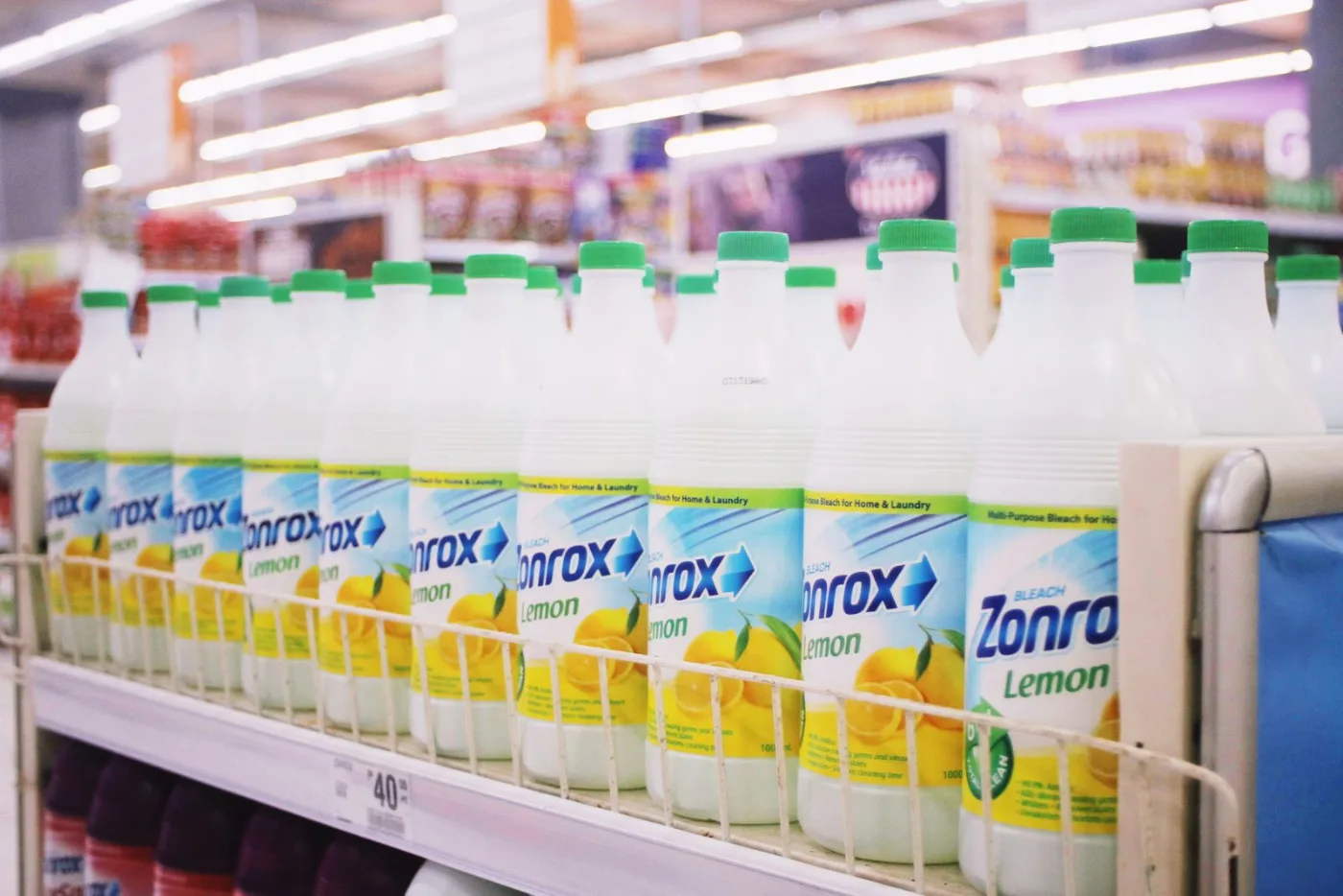
- Scented bleach (lemon, lavender and so on): fragrance oils can cloud water and cause foam.
- "Splash-less" or gel bleach: it's thickened and weaker, and the thickener can cloud the pool.
- Color-safe bleach: it's usually hydrogen peroxide, not chlorine.
- Bleach with cleaners or detergents added.
Check the label for "sodium hypochlorite" and the percentage, and for nothing else listed as active.
How much bleach to add to a pool
These amounts raise free chlorine by 1 ppm in 10,000 gallons. Multiply by the ppm you need and by your gallons ÷ 10,000.
| Product strength | Fl oz for +1 ppm per 10,000 gal |
|---|---|
| 6% bleach | 20.4 |
| 7.5% bleach | 16.0 |
| 8.25% bleach | 14.4 |
| 10% pool chlorine | 12.8 |
| 12.5% pool chlorine | 10.2 |
These match EPA-registered sodium hypochlorite labels. A 6% product's label calls for 107–213 fl oz per 10,000 gallons to reach 5–10 ppm, which is about 21 fl oz per ppm.
Not sure of your pool's volume? Use the pool volume calculator, then the pool chlorine calculator, which has a household bleach option.
Does bleach save money? A worked example
- The pool: Dan has a 20,000-gallon pool. Free chlorine is 1 ppm and he wants 4 ppm, an increase of 3 ppm.
- 8.25% bleach: 14.4 × 3 × 2 = 86 fl oz, about 0.7 of a 121-oz jug. At $5 a jug, that's about $3.60.
- 12.5% pool chlorine: 10.2 × 3 × 2 = 61 fl oz, about half a gallon. At $6 a gallon, that's about $2.90.
Per ppm, the cheaper choice is whichever costs less after you allow for strength. Divide the price by the fl oz needed for 1 ppm. Bleach wins when it's on sale or pool chlorine is hard to find. Otherwise pool chlorine is often equal or cheaper, and you carry fewer jugs.
(Dan is an illustrative example; prices vary by store and season.)
How to add bleach to a pool
- Test free chlorine, pH and CYA first.
- Work out the dose for the ppm you need.
- Pour slowly in front of a return jet with the pump running, or walk it around the deep end. Don't pour it into the skimmer if you use tablets there.
- Never mix bleach with acid or other chemicals. Add them at least 30 minutes apart.
- Wait about 30 minutes, then retest. Swim when free chlorine is 4 ppm or lower and pH is 7.2–7.8. See how long after adding chlorine you can swim.
Add bleach in the evening so sunlight doesn't burn it off right away.
Downsides of using bleach
- It weakens with time. The EPA-registered label for a 5.25% product warns that sodium hypochlorite "degrades with age and exposure to sunlight and heat." Buy what you'll use within a few weeks, store it cool and dark, and test after dosing.
- More volume to handle: you'll carry, pour and recycle more jugs than with pool chlorine.
- No stabilizer: in an outdoor pool, add CYA separately and keep it at 30–50 ppm, or the sun will destroy most of the chlorine in a few hours. Use the pool stabilizer calculator.
- pH creeps up slightly, the same as with liquid chlorine. Keep acid on hand; see how to lower pH.
- Shocking takes a lot: reaching 10+ ppm in a large pool with 6% bleach can mean several jugs at once.
Frequently asked questions
Can you use bleach instead of chlorine in a pool?
Yes. Plain, unscented bleach is sodium hypochlorite, the same chemical as liquid pool chlorine. You need more of it because it's weaker.
Is bleach the same as pool chlorine?
Chemically, yes. Household bleach is usually 6–8.25% sodium hypochlorite; liquid pool chlorine is 10–12.5%. Tablet and powder chlorine are different chemicals.
How much bleach do I put in a 10,000-gallon pool?
About 14–15 fl oz of 8.25% bleach per 1 ppm, or about 20 fl oz of 6% bleach. To raise chlorine from 1 to 4 ppm, use roughly 43 fl oz of 8.25% bleach.
Can I shock my pool with bleach?
Yes, but it takes a lot. Reaching 10 ppm in 10,000 gallons takes about 144 fl oz (more than one 121-oz jug) of 8.25% bleach. See the pool shock calculator.
What kind of bleach is safe for pools?
Only plain, unscented bleach whose label lists sodium hypochlorite as the only active ingredient. Avoid scented, splash-less, gel and color-safe types.
Can I use bleach in a salt water pool?
Yes. Adding bleach to a salt pool is the same as adding liquid chlorine. It's a good way to boost chlorine after a storm or party.
The bottom line
- Plain bleach works exactly like liquid pool chlorine. It's just weaker.
- Use about 14–15 fl oz of 8.25% bleach per ppm per 10,000 gallons.
- Avoid scented, splash-less and color-safe bleach, and use it fresh.
- Keep CYA at 30–50 ppm in outdoor pools, and compare cost per ppm, not per jug.
Sources
- US EPA, registered label, Sodium Hypochlorite 6% (EPA Reg. No. 9436-5, 2025): 107–213 fl oz per 10,000 gal yields 5–10 ppm; re-entry prohibited above 4 ppm. https://www3.epa.gov/pesticides/chem_search/ppls/009436-00005-20251208.pdf
- US EPA, registered label, HYPO 5.25 (EPA Reg. No. 49927-5, 2020): pool directions; "degrades with age and exposure to sunlight and heat." https://www3.epa.gov/pesticides/chem_search/ppls/049927-00005-20200218.pdf
- Indiana Department of Health, Water Chemistry Adjustment Guide: 12% liquid chlorine dose per ppm per 10,000 gal. https://www.in.gov/health/eph/files/Chemical_adjustment_pool.pdf
- CDC, Home Pool and Hot Tub Water Treatment and Testing (2024). https://www.cdc.gov/healthy-swimming/about/home-pool-and-hot-tub-water-treatment-and-testing.html

What do you think?
Share your experience, ask a question, or help another reader.
Loading comments…