
Swimming Pool Metal Stains: Identification, Causes, Removal & Prevention
Last reviewed November 22, 2026
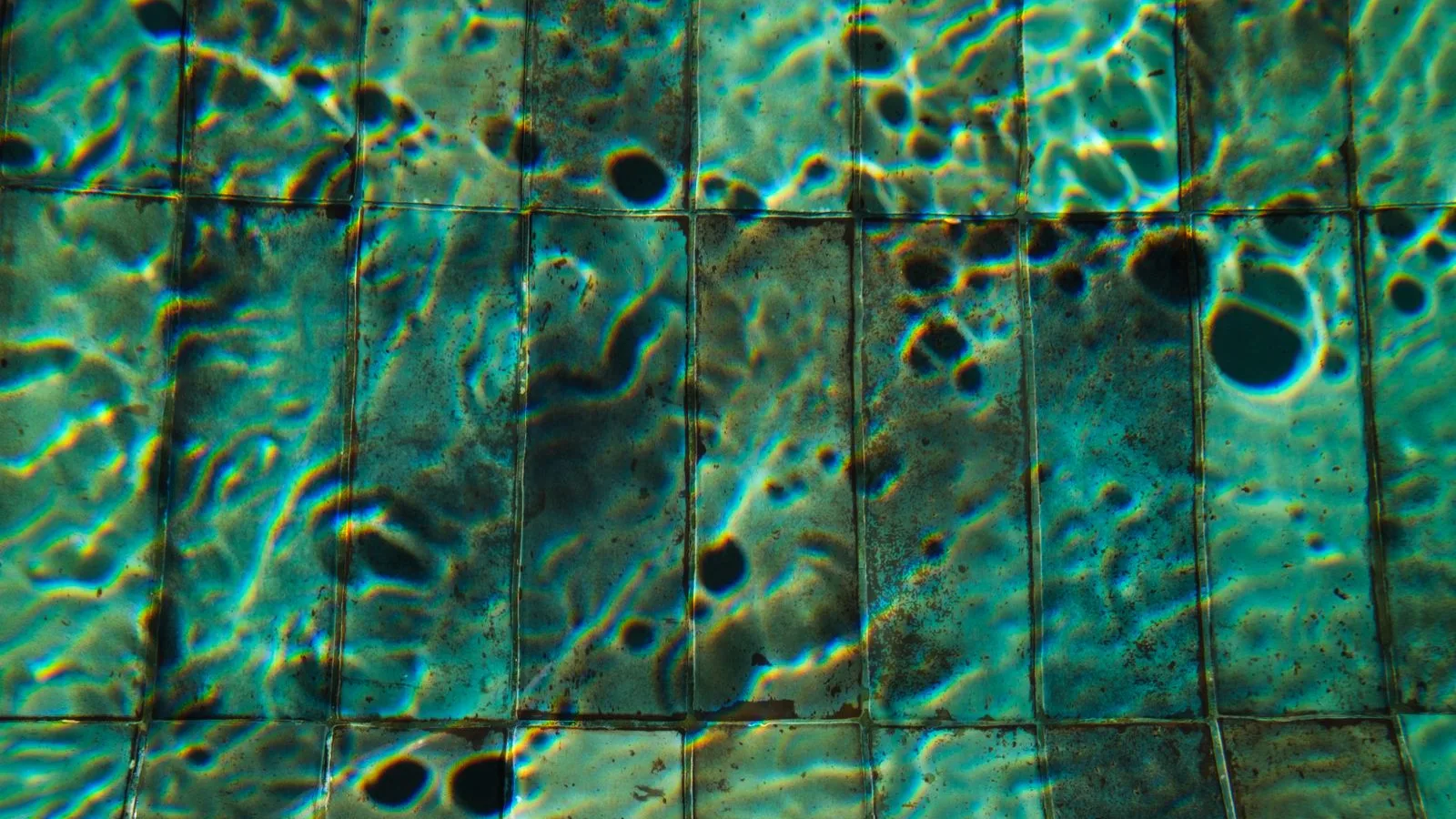
Quick answer: Metal stains form when dissolved iron, copper or manganese comes out of the water and deposits on pool surfaces, often after shocking, a pH change, or adding fill water that contains metals.
- Typical colors: iron tends to leave rust or brown stains, copper blue-green or teal (sometimes gray or black), and manganese black or brown-black.
- Color is only a clue. Confirm with a brush test, water testing and a vitamin C spot test.
- Treat in two parts: lift the stain from the surface with a labeled stain treatment, then manage the metals left in the water with a sequestrant, filtration or partial water replacement, and fix the source.
How metal stains form
Metals can be dissolved in clear water without being visible. Extension and health-department guidance notes that dissolved iron and manganese react with chlorine and other oxidants and form particles, so shocking water that contains metals can turn it colored and leave stains. Many metals are also less soluble at higher pH.
Metals usually get into a pool from:
- Fill and top-off water, especially private wells, which commonly contain iron and manganese.
- Corrosion of copper or brass plumbing, fittings and heater parts when pH or alkalinity runs low.
- Copper-based algaecides and ionizers, which add copper on purpose.
- Metal debris such as nails, hair pins, coins or tools left in the pool.
Iron, copper or manganese?
| Metal | Colors often reported | Common sources |
|---|---|---|
| Iron | Rust, orange, reddish-brown, brown | Well water, rusting metal parts and debris |
| Copper | Blue-green, teal; can look gray, brown or black on plaster | Low-pH corrosion of copper plumbing and heater parts, copper algaecides, ionizers |
| Manganese | Black, brownish-black, sometimes purplish | Well water, some municipal water |
The US EPA's secondary drinking water guidelines link iron with "reddish or orange staining" above 0.3 mg/L, copper with "blue-green staining" above 1.0 mg/L, and manganese with "black staining" above 0.05 mg/L. In a pool, colors overlap and change with the surface and lighting, so use them as a first guess only.
Stain, algae or something else?
| What you see | Likely cause | Quick check |
|---|---|---|
| Doesn't brush off; brown, rust, blue-green, gray or black | Metal stain | A vitamin C tablet held on the spot for about 30 seconds often lightens iron stains |
| Brown or tan marks under leaves or debris | Organic stain | A little chlorine on the spot often lightens it (not on vinyl) |
| Green, yellow or black patches that brush off and regrow | Algae | Brush it and watch for regrowth. See our mustard algae guide |
| White or gray crust, often at the waterline | Mineral scale | Rough to the touch; linked to high pH and calcium |
How to treat metal stains
- Test the water: free chlorine, pH, alkalinity, calcium hardness, stabilizer and metals. A low metals reading doesn't rule out a stain, because metal on the walls isn't in the water sample.
- Fix the source: correct low pH and alkalinity, check copper products and heater history, and test your fill water.
- Use a stain treatment labeled for your surface. Small fresh stains may respond to a spot treatment; widespread stains may need a whole-pool treatment. Many are ascorbic-acid based and require lower chlorine first. Follow the label.
- Add a sequestrant as the label directs so freed metals stay dissolved instead of re-staining. A sequestrant holds metals in the water; it doesn't remove them.
- Restore chlorine and pH gradually, then reduce the metal load with metal-removal filter products or partial water replacement where your pool type and local rules allow.
- Call a professional for set-in stains, uncertain diagnoses, or anything involving draining or acid washing.
For removing dissolved metals from the water, see how to remove copper and iron from pool water.
Safety: never mix pool chemicals, including chlorine and acid or different chlorine types. Add each product separately to the water, following its label, and wear the gloves and eye protection the label calls for. Don't apply strong acids to pool surfaces yourself. In an emergency call 911; for exposure questions call Poison Control at 1-800-222-1222.
How to prevent metal stains
- Test fill water, especially well water, and use a fill-hose pre-filter if it contains metals.
- Keep pH and alkalinity in range to protect metal parts from corrosion.
- Add a sequestrant when filling or after adding a lot of new water to metal-bearing water, and maintain it as the label directs.
- Follow label limits for copper algaecides. A registered copper algaecide label tells users to test for metals first and warns that full-strength product stains porous surfaces.
- Remove metal debris promptly, and act on new stains early.
Frequently asked questions
Why did my pool turn brown or green after shocking?
Shocking oxidizes dissolved metals, which can tint the water and then settle as stains. Test for metals before adding more oxidizer.
Does a sequestrant remove metals?
No. It keeps metals dissolved so they're less likely to stain. Metals leave through filtration media or water replacement.
Why is my hair turning green in the pool?
Copper in the water binds to hair, especially hair already damaged by bleaching or sun. Check pH and copper sources.
References
- US EPA, Secondary Drinking Water Standards: Guidance for Nuisance Chemicals. https://www.epa.gov/sdwa/secondary-drinking-water-standards-guidance-nuisance-chemicals
- Virginia Cooperative Extension, Iron and Manganese in Household Water (442-656). https://pubs.ext.vt.edu/442/442-656/442-656.html
- Multnomah County Health Department, Pools and Spas: Troubleshooting (2016). https://multco.us/file/52715/download
- Los Angeles Department of Water and Power, Green Hair: Causes and Cures (2021). https://webprod.ladwp.com/sites/default/files/documents/Green_Hair_Causes_and_Cures.pdf
- US EPA Pesticide Product Label System, copper algaecide label, EPA Reg. No. 5185-473 (2025). https://www3.epa.gov/pesticides/chem_search/ppls/005185-00473-20250113.pdf
- CDC, Pool Chemical Injuries in Public and Residential Settings, United States, 2008–2017. MMWR 68(19), 2019. https://www.cdc.gov/mmwr/volumes/68/wr/mm6819a2.htm